
 By
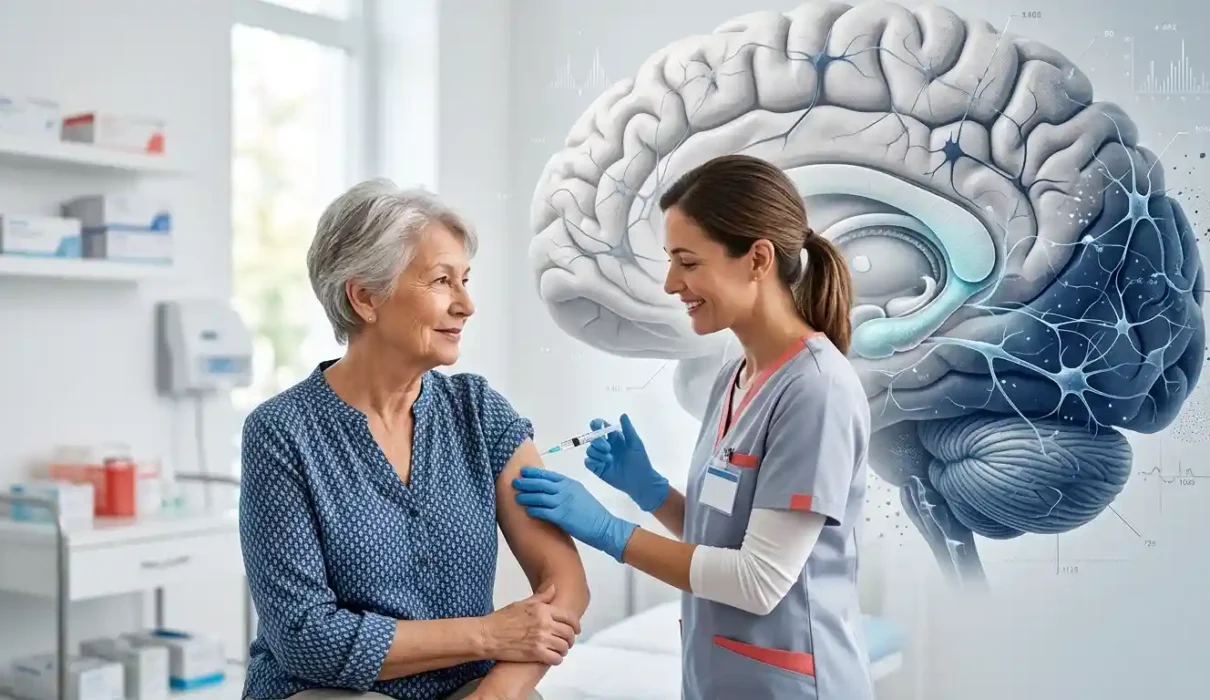
By Older adults who received at least one dose of the recombinant shingles vaccine Shingrix had a 24% lower relative risk of being diagnosed with dementia over the next four years compared with those who did not receive the vaccine, according to new research from Brown University.
The findings, published in Annals of Internal Medicine, add to a growing body of evidence suggesting that shingles vaccination may be associated with better brain health in later life. Researchers stress that the study shows an association, not proof that the vaccine itself prevents dementia.
What the new study found
The study was led by Kaleen N. Hayes, associate director of pharmacoepidemiology at the Brown University School of Public Health, and colleagues at Brown, the University of Delaware and the Providence Veterans Affairs Medical Center.
Researchers analyzed Medicare claims and electronic health records from 509,926 adults aged 66 and older who were admitted to more than 5,500 skilled-nursing facilities in the United States for short-term post-acute care or long-term care between 2017 and 2022. The admission served as a clear clinical checkpoint.
To be eligible, participants had to have no prior diagnosis of dementia and be eligible to receive the recombinant zoster vaccine, known as RZV or by the brand name Shingrix. Shingrix is the only shingles vaccine currently available in the US, introduced in 2017.
Of the half-million people included, only 8,843 received at least one dose of Shingrix during their nursing facility stay or within 12 months after. The team then followed both groups for up to four years.
Over that period, 18.8% of vaccinated adults developed dementia compared with 24.6% of those who remained unvaccinated. After adjusting for differences in age, health status and other factors, the researchers calculated a risk ratio of 0.76 (95% confidence interval 0.69 to 0.84), which translates to a 24% lower relative risk.
In absolute terms, the difference was about 5.8 percentage points. The authors estimated that this would equate to roughly one dementia diagnosis potentially prevented for every 17 people vaccinated in this very high-risk population.
The study used a method called target trial emulation with clone-censor-weighting, designed to mimic a randomized trial using observational data when a real trial is not practical. Funding was provided by GSK, which makes Shingrix, but the authors noted the company had no control over design, analysis or publication.
You can read the Brown University summary of the study and the original paper, Dementia Risk After Recombinant Herpes Zoster Vaccination in Older Adults in Annals of Internal Medicine.
What does a 24% lower dementia risk mean?
The 24% figure is a relative risk reduction, not an absolute reduction for any one person.
It means that, in this study population, the rate of new dementia diagnoses was 24% lower in the vaccinated group than in the unvaccinated group after accounting for other factors. It does not mean that 24% of people avoided dementia because of the vaccine, nor that the vaccine prevents dementia in 24% of recipients.
The absolute difference — 18.8% versus 24.6% over four years — gives a more concrete sense of what was observed in this particularly vulnerable group of older adults with recent skilled-nursing care. In healthier, community-dwelling older adults, the absolute rates of dementia would be lower, so the same relative reduction would translate to a smaller absolute benefit.
Relative risk figures can sound larger than absolute differences. Understanding both helps avoid overstating what an observational study can tell us.
Why might the shingles vaccine affect dementia risk?
Scientists do not yet know why shingles vaccination appears linked to lower dementia risk, and the Brown study was not designed to answer that question. Several plausible mechanisms are being discussed in the literature:
- Preventing viral reactivation: Shingles is caused by reactivation of the varicella-zoster virus, the same virus that causes chickenpox and remains dormant in nerve cells for life. Reactivation causes inflammation of nerves and skin. Repeated or severe reactivation has been proposed as a contributor to neuroinflammation.
- Reducing systemic inflammation: Infections can trigger inflammatory responses that may affect the brain over time. By preventing shingles, vaccination might reduce episodes of inflammation.
- Immune system training: Some researchers have suggested that vaccines, including adjuvanted vaccines like Shingrix, may have non-specific effects on the immune system, sometimes described as trained immunity, that modulate inflammatory pathways linked to dementia.
- Preventing complications that affect brain health: Shingles pain, hospitalization and reduced activity after shingles could indirectly influence cognitive reserve and detection of dementia.
These remain hypotheses. Other studies have also found that antiviral drugs used to treat shingles were associated with lower dementia risk, while a diagnosis of shingles itself was associated with higher risk, supporting the idea that the virus itself may play a role. None of this establishes causation.
What is Shingrix and what does it protect against?
Shingles, also called herpes zoster, is a painful rash that usually appears as a band of blisters on one side of the chest, abdomen or face. It is caused by reactivation of varicella-zoster virus. Almost everyone who had chickenpox as a child carries the virus. Risk increases with age, particularly after 50, and in people with weakened immune systems.
According to CDC information on shingles, about 1 in 3 people in the US will develop shingles in their lifetime. Complications can include postherpetic neuralgia, a prolonged nerve pain that can last months or years, as well as eye complications and, rarely, neurological problems.
Shingrix is a recombinant, adjuvanted vaccine. It contains a piece of the virus surface protein combined with an adjuvant that boosts immune response. It is not a live vaccine. In the US, the CDC recommends two doses of Shingrix for adults aged 50 and older, and for adults 19 and older who are immunocompromised, to prevent shingles and its complications.
In clinical trials, Shingrix was more than 90% effective at preventing shingles in adults 50 and older in the first few years after vaccination, with protection waning somewhat over time but remaining substantial. In the UK, NHS guidance on shingles vaccination recommends the vaccine for adults turning 65, those aged 70 to 79, and those 50 and over with a severely weakened immune system.
Common side effects are generally short-lived and include pain and redness at the injection site, muscle aches, fatigue, headache, shivering and stomach upset. More serious side effects are uncommon. The vaccine’s established purpose remains prevention of shingles, not dementia.
What dementia is, and why researchers are looking at risk factors
Dementia is not a single disease but a syndrome caused by damage to brain cells that affects memory, thinking, language and daily functioning beyond what is expected in normal ageing. Alzheimer’s disease is the most common cause, accounting for 60-70% of cases, but vascular dementia, Lewy body dementia and mixed forms are also common.
According to the Alzheimer’s Association information on dementia and the Alzheimer’s Society guidance on what dementia is, age remains the strongest risk factor, but research has identified potentially modifiable factors including cardiovascular health, hearing loss, education, smoking, depression, physical inactivity and social isolation.
Because there is currently no cure that reverses dementia, interest has grown in whether preventing infections that cause inflammation might influence risk. Vaccination is one area being explored, but experts caution that association studies alone cannot establish a prevention strategy.
What the study does not prove
This was an observational cohort study, not a randomized controlled trial. It cannot prove that Shingrix lowers dementia risk or that it should be used for that purpose.
The authors themselves emphasized that they cannot say with certainty that the vaccine caused the lower rate of dementia diagnoses. The study reports an association observed in routinely collected health data.
It also focused on a specific population: older US adults with recent skilled-nursing facility stays, a group that is older, frailer and at higher baseline risk of dementia than the general older population. Only about 1.7% of the cohort received the vaccine, reflecting low uptake in this setting during the study period.
The results align with earlier research on an older live shingles vaccine, Zostavax, and with two natural-experiment studies in Wales that found lower dementia diagnoses after vaccine eligibility changes, but those studies also could not establish causation.
What are the limitations of the research?
Several limitations affect interpretation:
- Healthy vaccinee effect: People who received the vaccine tended to be slightly younger and healthier and may have had better access to preventive care. The team adjusted statistically for many measured differences, but unmeasured differences can remain in observational data.
- Healthcare utilization: Vaccinated individuals may see doctors more regularly, which could affect both vaccination and how or when dementia is diagnosed and recorded in claims data.
- Dementia ascertainment: Dementia diagnoses were identified from Medicare claims and health records, not from standardized cognitive testing. Some cases may be missed or delayed, and coding practices vary.
- Short follow-up for dementia: Four years is relatively short for a condition that develops over many years. Longer follow-up is needed to see whether differences persist.
- Generalizability: Findings from frail, nursing-facility-exposed Medicare beneficiaries may not apply to younger, healthier community-dwelling adults in other countries or health systems.
- Need for trials: Only randomized trials that prospectively assign people to vaccine or control and follow cognition with formal testing can determine whether there is a causal protective effect.
The authors and independent experts agree that further research is needed before any clinical recommendations about dementia prevention could be considered.
What this means for older adults
The current value of the study is as a piece of emerging evidence, not as a change in medical guidance.
Shingrix remains recommended to prevent shingles and postherpetic neuralgia, which themselves can be debilitating. Decisions about vaccination should be based on those established benefits and on national recommendations, not solely on a potential dementia association that has not been proven.
People who have questions about whether Shingrix is appropriate for them should speak with their primary care clinician, pharmacist or local health authority. In the US, that means following CDC guidance on shingles vaccines; in the UK, following NHS shingles vaccine eligibility.
Maintaining brain health still rests on measures with stronger evidence: managing blood pressure and diabetes, avoiding smoking, staying physically and socially active, treating hearing loss, and seeking prompt evaluation for memory concerns.
If future trials confirm that preventing shingles or boosting specific immune pathways does lower dementia risk, it would point to a widely available tool that could complement other prevention efforts. For now, the link remains intriguing but unproven.

Dr. Samuel Kemp is a Consultant Physician at the Royal Brompton Hospital with specialist expertise in respiratory medicine, including lung cancer, COPD, and advanced interventional bronchoscopy.