
 By
Exoskeleton Robots vs Knee Orthoses: Differences, Benefits and Uses
Wearable technology is transforming how people recover mobility after injury and manage long-term joint conditions. Two very different devices often appear in the same conversation: lower limb exoskeleton robots and knee orthoses, commonly known as knee braces.
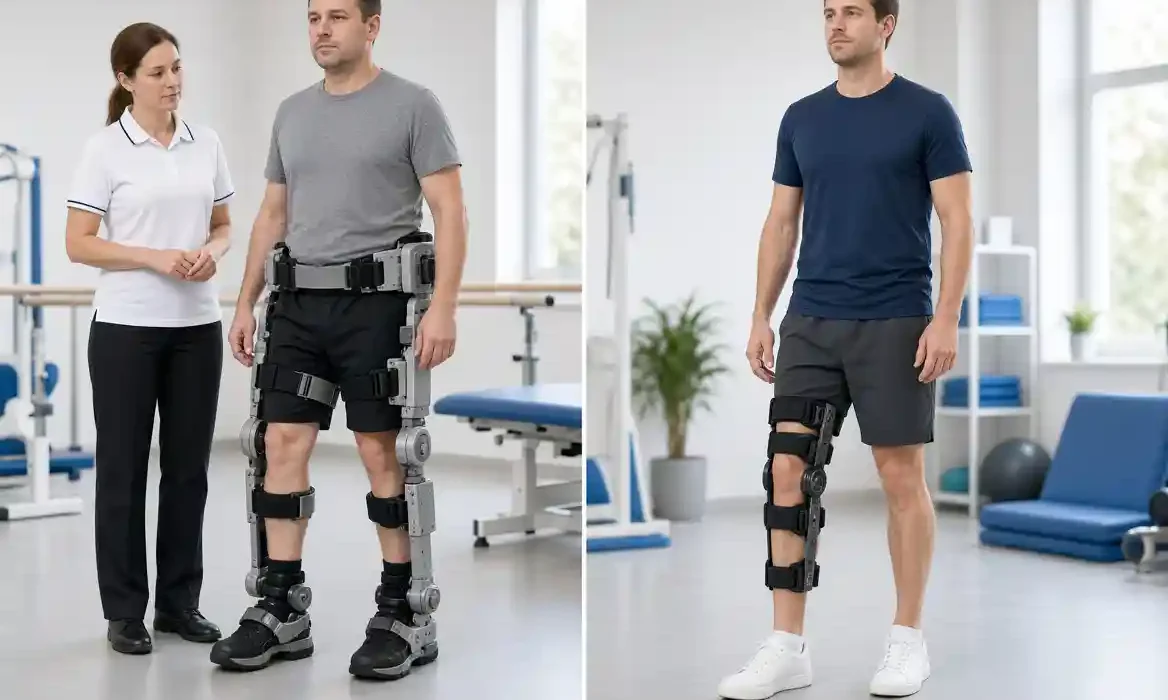
Both are worn on the legs and both aim to improve function, but they work in fundamentally different ways. A knee orthosis provides passive mechanical support to one joint, while a robotic exoskeleton for walking uses motors, sensors and control software to actively assist leg movement. Understanding these differences helps patients, families and clinicians set realistic expectations and choose appropriate rehabilitation technology.
What Are Lower Limb Exoskeleton Robots?
Lower limb exoskeleton robots are wearable robotic devices that fit around the hips, thighs and lower legs. Powered systems use electric motors or actuators at the hip and knee joints, combined with sensors that detect joint angles, weight shift and sometimes muscle activity. A control unit interprets this information to assist or generate stepping movements.
Not all exoskeletons are the same:
- Clinical rehabilitation exoskeletons are used in hospitals and physiotherapy centres to provide repetitive gait training. Examples include systems used for stroke rehabilitation where a therapist supervises sessions. The goal is often to enable high repetitions of stepping practice early after injury.
- Personal mobility exoskeletons are designed for over-ground walking outside the clinic, sometimes for people with complete spinal cord injury who use crutches for balance.
- Industrial, military and recreational exoskeletons are designed to reduce fatigue or augment strength for workers and are not medical devices.
- Passive and soft exoskeletons / exosuits use springs, elastic bands or textile structures to assist movement without large motors.
In rehabilitation, lower limb robotic exoskeletons have been studied for stroke, spinal cord injury and other neurological conditions. According to the National Institutes of Health, they can allow people with severe weakness to practice walking with support, but they require careful patient selection, fitting and supervision.
Capabilities differ substantially. Some devices support only treadmill-based training with partial body-weight support, while others support over-ground walking. Battery life, weight, walking speed and need for assistance vary by model.
What Are Knee Orthoses?
Knee orthoses are external supports worn around the knee to improve stability, alignment, or to limit movement while tissues heal. Unlike powered exoskeletons, conventional knee braces provide passive mechanical support rather than powered walking assistance.
Common types include:
Functional knee braces
Designed to provide stability for an unstable knee, for example after ligament injury. They typically have rigid side bars and hinges to limit excessive motion.
Rehabilitative braces
Used after injury or surgery to restrict range of motion while healing occurs. Often adjustable to gradually allow more flexion and extension.
Unloader braces for osteoarthritis
These apply a force to shift load away from the damaged compartment of the knee, usually the medial compartment in knee osteoarthritis. By reducing pressure on the affected area, they may reduce pain during walking for some people.
Prophylactic braces
Worn to reduce risk of injury in high-impact sports. Evidence for injury prevention is mixed and they do not guarantee protection.
Hinged and custom-fitted orthoses
Orthoses may be off-the-shelf or custom-made from a cast or 3D scan. Hinged designs allow controlled flexion while preventing sideways movement. Custom fitting improves alignment but increases cost and lead time.
Knee orthoses are prescribed widely in orthopaedics and physiotherapy. The NHS notes that braces can support recovery but must be fitted correctly and used alongside exercise and rehabilitation.
Exoskeleton Robots vs Knee Orthoses: Key Differences
This comparison summarises typical characteristics. Individual products vary, so specifications should be checked with the manufacturer and clinician.
| Feature | Lower Limb Exoskeleton Robots | Knee Orthoses (Knee Braces) |
|---|---|---|
| Primary purpose | Assist or generate leg movement for gait training or mobility | Stabilise, align, unload or restrict movement of the knee joint |
| Technology | Motors, batteries, sensors, control algorithms; some soft exosuits use textiles and elastic | Passive: rigid frames, hinges, straps, padding; materials such as aluminium, carbon fibre, neoprene |
| Active vs passive assistance | Active powered assistance; can move joints even without voluntary muscle effort | Passive mechanical support; relies on user’s own muscle activity |
| Common medical applications | Stroke rehabilitation, spinal cord injury, selected neuromuscular conditions under supervision | Knee osteoarthritis, ACL and ligament injuries, meniscal injuries, post-surgical recovery, patellofemoral pain |
| Mobility support | Can enable supported standing and stepping, often with walking aids | May improve knee stability and confidence while walking but does not generate steps |
| Weight and portability | Typically 12–25 kg for full lower-limb systems; heavier, needs charging | Usually 0.3–2 kg; lightweight and portable |
| Training requirements | Extensive training for users and therapists; fall safety protocols | Brief training on fitting, wearing time and skin checks |
| Comfort and fitting | Requires precise alignment of robotic joints with anatomical joints; fitting time 15–45 minutes | Requires proper sizing; custom devices need casting; can cause pressure or skin irritation if ill-fitted |
| Maintenance | Software updates, battery management, mechanical servicing | Cleaning, strap replacement, hinge checks |
| Cost and accessibility | Clinical systems often tens to hundreds of thousands; personal devices high-cost and limited availability | Consumer braces £20–£200; custom orthoses £300–£1,500+; widely available |
| Potential limitations | High cost, limited battery, not suitable for all, fall risk, needs specialist centre | Does not restore muscle power, may cause discomfort, limited benefit if not combined with rehabilitation |
Benefits and Limitations of Robotic Exoskeletons
Potential benefits
- Supported walking practice: Allow people with severe weakness to practice standing and stepping earlier than would be possible unaided, which may support cardiovascular health and bone loading.
- Repetitive gait training: Can deliver high numbers of steps in a session with consistent guidance, useful when therapist resources are limited.
- Motivation and feedback: Some systems provide visual feedback on symmetry or weight shift, which may encourage active participation.
Research on exoskeleton rehabilitation shows improvements in walking speed or endurance during or shortly after training programmes for some stroke survivors, but evidence for lasting gains in independent walking compared with conventional therapy is still evolving. The Stroke Association and Cochrane reviews emphasise that robotic training should complement, not replace, conventional physiotherapy.
Limitations to consider
- Clinical supervision required: Most powered exoskeletons are intended for use with trained staff, harnesses and safety checks.
- Patient selection: Height, weight, bone density, spasticity, skin integrity and cardiovascular stability affect suitability.
- Device-assisted vs independent gains: Improvements seen while wearing the device do not automatically translate to unaided walking.
- Practical constraints: Weight, donning time, battery life of 1–4 hours, need for crutches or walker, and limited use on stairs or uneven ground.
- Safety: Risk of falls, fractures with improper fitting, and skin pressure injuries require monitoring.
Benefits and Limitations of Knee Orthoses
Potential benefits
- Stability and confidence: An appropriately selected knee brace may improve sense of stability after ligament injury.
- Protection during healing: Rehabilitative braces limit harmful movements after surgery or injury.
- Pain reduction in osteoarthritis: For some people with medial knee osteoarthritis, unloader braces may reduce pain during walking, potentially delaying need for further intervention when combined with exercise and weight management.
Guidance from the National Institute for Health and Care Excellence (NICE) for osteoarthritis emphasises exercise, education and weight management as core treatments; braces may be considered as an adjunct for selected individuals.
Limitations to consider
- Comfort and skin issues: Pressure points, warmth, slippage and irritation are common, especially with prolonged wear.
- Fitting matters: An improperly fitted brace can be ineffective or increase discomfort. Custom devices require assessment by an orthotist.
- Variable evidence: Effectiveness differs by condition, brace design and adherence. Braces do not reliably prevent all injuries and do not replace strengthening.
- Muscle weakness risk: Over-reliance without exercise may reduce muscle activity; rehabilitation should include strengthening.
Which Device Is Better for Different Conditions?
Exoskeleton robots and knee orthoses are not interchangeable. Selection depends on diagnosis, functional ability and rehabilitation goals.
Knee osteoarthritis
A knee orthosis for osteoarthritis, particularly an unloader brace, may be considered for medial compartment osteoarthritis to reduce load and pain. Powered exoskeletons are not routine for osteoarthritis; lightweight powered knee orthoses and soft exosuits are emerging but remain experimental for this indication.
ACL injuries
Functional knee braces may provide subjective stability after anterior cruciate ligament injury or reconstruction, but they do not replace surgical assessment and neuromuscular rehabilitation. Exoskeletons are not standard for isolated ACL injuries.
Recovery after knee surgery
Rehabilitative braces with adjustable range of motion are commonly used after ligament repair or fracture fixation to protect healing structures. Use should follow surgeon and physiotherapist guidance.
Stroke rehabilitation
Robotic exoskeletons for stroke rehabilitation may be used in early subacute phases to increase stepping practice for selected patients who cannot walk independently. Knee orthoses such as knee-ankle-foot orthoses may be used for knee instability during stance. Decisions depend on strength, spasticity and walking ability.
Spinal cord injury
For people with complete or severe incomplete spinal cord injury, lower limb exoskeletons can enable supported standing and walking with aids in supervised settings, offering physiological benefits. Knee orthoses alone are insufficient to enable walking in complete injuries but may be part of orthotic management for incomplete injuries.
Neuromuscular weakness
In conditions causing quadriceps weakness, a knee-ankle-foot orthosis with stance control or a powered knee orthosis may help prevent knee buckling. Soft exosuits are being investigated to assist hip and knee extension with less bulk.
In all cases, assessment by a qualified physiotherapist, orthotist or rehabilitation physician is essential.
Costs and Availability
Costs vary widely by country, model, customisation and service support:
- Consumer knee braces: Basic neoprene sleeves and hinged braces typically £20–£200 in the UK when purchased retail.
- Custom knee orthoses: Custom-fitted functional or unloader braces made by an orthotist often range £300–£1,500+, including assessment, fitting and follow-up. Complex carbon fibre designs cost more.
- Clinical rehabilitation exoskeletons: Systems intended for hospital use often cost £80,000–£250,000+, plus service contracts, training and staffing. They are not typically sold directly to individuals.
- Personal-use robotic exoskeletons: Devices cleared for personal use, where available, have been reported in the range of £30,000–£100,000+ and often require assessment, training and maintenance agreements.
These figures are indicative based on manufacturer listings, NHS procurement reports and rehabilitation technology reviews in 2024–2026 and should not be taken as current quotes. Insurance coverage varies significantly. In the UK, knee orthoses may be provided via NHS orthotics services when clinically indicated, while robotic exoskeleton access is largely limited to specialist rehabilitation centres and research programmes. In the US and other countries, coverage depends on insurer, medical necessity documentation and regulatory clearance. Always check local availability and funding criteria.
The Future of Wearable Rehabilitation Technology
The boundary between the two categories is beginning to blur. Emerging developments include:
- Powered knee orthoses: Lightweight devices that add motorised assistance to a traditional knee brace to help with sit-to-stand and swing-phase assistance.
- Soft exosuits: Textile-based systems using cables and small actuators to assist hip and knee movement with less rigid structure, aiming to improve comfort and portability.
- Adaptive control systems: Algorithms that adjust assistance based on real-time gait analysis, muscle activity or user intent.
- Lighter actuators and batteries: Improving wear time and reducing overall system weight.
While these innovations are promising, many remain in research or early clinical evaluation. Established clinical applications for powered exoskeletons are currently in supervised gait training for selected neurological conditions, not as general-purpose replacements for knee braces. Anyone considering experimental technology should discuss risks, benefits and evidence with their clinical team and ensure devices have appropriate regulatory clearance, such as UKCA or CE marking.
Final Thoughts
The comparison of exoskeleton robots vs knee orthoses is not about which technology is superior overall, but which is appropriate for a specific person and goal.
Knee orthoses offer accessible, low-cost, passive support for knee stability, protection and unloading. They are widely used for osteoarthritis, ligament injuries and post-surgical rehabilitation when combined with exercise and professional fitting.
Lower limb exoskeleton robots provide active, powered walking assistance and can enable repetitive gait training for people with severe weakness due to stroke or spinal cord injury under clinical supervision. They involve higher cost, training and safety considerations and are not a substitute for knee bracing in most orthopaedic conditions.
Choosing between a powered exoskeleton vs knee brace should involve a thorough assessment by a physiotherapist, orthotist or rehabilitation doctor who can consider diagnosis, functional ability, goals, environment and funding. Both technologies continue to evolve as part of broader wearable rehabilitation technology, offering more personalised options for mobility support.
Frequently Asked Questions
What is the difference between an exoskeleton and a knee orthosis?
An exoskeleton is a robotic device with motors and sensors that actively helps move the legs, while a knee orthosis is a passive brace that stabilises, aligns or unloads the knee joint. Exoskeletons can generate stepping, whereas knee braces rely on your own muscle strength and mainly provide support and protection.
Can robotic exoskeletons help people walk again?
Robotic exoskeletons can help some people practice walking with support during rehabilitation, particularly after stroke or spinal cord injury. They may improve walking ability while wearing the device and in some cases after training, but they do not guarantee restoration of independent walking. Outcomes depend on injury severity, time since injury and comprehensive rehabilitation.
Are knee orthoses effective for osteoarthritis?
For some people with knee osteoarthritis, especially medial compartment osteoarthritis, unloader knee braces may reduce pain and improve function during walking when combined with exercise, education and weight management. Benefit varies, and braces work best when properly fitted by an orthotist and used as part of a broader management plan recommended by NICE.
Are robotic exoskeletons safe for rehabilitation?
When used with appropriate patient selection, trained staff, safety harnesses and fitting protocols, exoskeletons are generally considered safe in clinical settings. Risks include falls, skin pressure injuries and discomfort if misaligned. They should only be used after assessment and with supervision in facilities experienced in their use.
How much do exoskeleton robots and knee braces cost?
Consumer knee braces typically cost £20–£200, custom orthoses £300–£1,500+, clinical rehabilitation exoskeletons £80,000–£250,000+ and personal-use exoskeletons tens of thousands of pounds. Prices vary by model, customisation and country. Funding and availability also vary, so check with local orthotics services or rehabilitation centres for current information.
Can a knee orthosis replace a robotic exoskeleton?
Generally no, because they serve different purposes. A knee orthosis cannot provide powered walking assistance for someone with severe paralysis, and a robotic exoskeleton is not a practical or necessary solution for isolated knee instability or osteoarthritis. In some cases, such as quadriceps weakness, a powered knee orthosis or stance-control orthosis may combine features of both, but selection requires professional assessment.
Medical disclaimer: This article is for educational purposes and does not constitute medical advice. It does not replace assessment by a qualified healthcare professional. Device selection, fitting and training should be undertaken with a physiotherapist, orthotist or rehabilitation physician. If you have new weakness, numbness, severe knee pain, swelling or injury, seek prompt medical attention.

Dr. Samuel Kemp is a Consultant Physician at the Royal Brompton Hospital with specialist expertise in respiratory medicine, including lung cancer, COPD, and advanced interventional bronchoscopy.