
 By
By You know that split-second when you plant your foot to change direction on the soccer field, or land awkwardly from a volleyball spike? For a moment, everything feels fine. Then you hear it—or rather, feel it. A weird pop from deep inside your knee, followed by a sinking sensation that something just came unhinged.
I’ve worked with dozens of athletes and active individuals who describe that exact moment. They usually limp off the field, hoping it’s just a twisted knee. But by the next morning, the swelling has blown up like a balloon, and walking downstairs feels terrifyingly wobbly. Chances are, you’re dealing with an ACL injury. Specifically, a Grade 2 ACL tear.
The good news first: Not every ACL injury requires a full surgical rebuild. A Grade 2 tear sits right in the middle of the injury spectrum. It’s painful, it’s unsettling, but with the right ACL treatment options, many people return to sport without going under the knife.
What is a Grade 2 ACL Tear? (Partial tear explained)
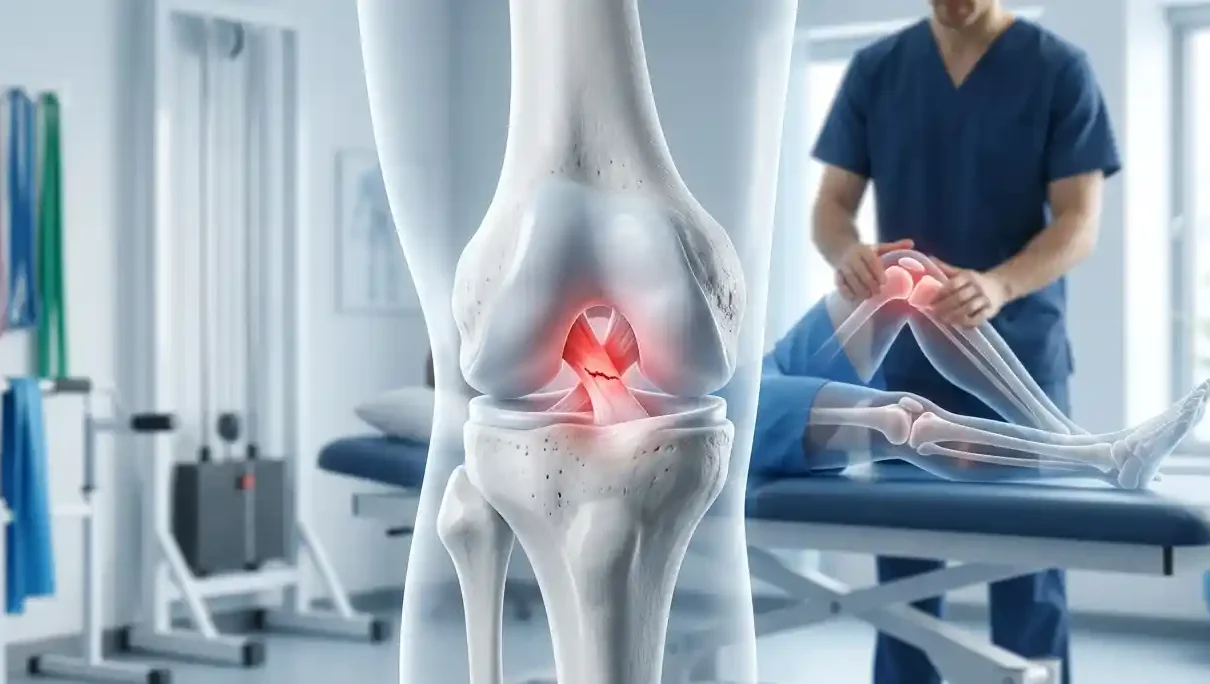
To understand a partial tear, you first have to appreciate what the Anterior Cruciate Ligament actually does. Think of it as the main “quarterback” of your knee stability. It runs diagonally through the middle of your knee, keeping your shin bone (tibia) from sliding out in front of your thigh bone (femur).
When doctors classify knee ligament injury, we use a simple scale from one to three.
- Grade 1 (Mild): The ligament is stretched, but not torn. Recovery is usually measured in weeks, not months.
- Grade 2 (Moderate): This is the partial ACL tear. The ligament fibers are stretched and partially ripped — like a frayed rope. Your knee might feel stable one moment and give out the next.
- Grade 3 (Severe): Complete rupture. The ligament is snapped in two. Without surgery, active people often feel a loose hinge.
So where does that leave you with a Grade 2 ACL tear? You have a knee that isn’t completely destroyed, but also isn’t trustworthy. That partial connection is both a blessing and a curse — it provides some stability (great for healing), but it can lull you into a false sense of security before you are truly ready to move.
How does a partial ACL tear happen?
Very rarely do I see a Grade 2 injury from a simple slip on ice. Usually, it’s a non-contact injury. You’re moving, stopping, or twisting, and your foot gets stuck while your body keeps turning.
- Sudden stops – running hard and trying to brake without proper mechanics.
- Pivoting with a planted foot – basketball, tennis, soccer players know this move well.
- Landing from a jump – quadriceps fire aggressively while the knee is almost straight.
- Hyperextension – direct blow to the front of the shin forces the knee backward.
I remember a patient a recreational skier who described it perfectly: “I wasn’t even going fast. I hit a rut, my ski didn’t release, and I felt my knee slide sideways. I thought I broke my leg.” That sensation of the femur and tibia moving independently is a classic sign of a partial ACL tear.
Real-life symptoms: what patients actually feel
Unlike a dramatic movie scene, a Grade 2 ACL tear is confusing. The symptoms often come in waves.
Immediate (first 30 minutes): You might finish the play. Adrenaline masks the pain. But as you walk to the sideline, you notice deep, aching pain inside the joint, not on the kneecap. Some feel a “shift” — like the knee briefly became a hinge in the wrong direction.
Swelling phase (next 2–4 hours): This is the dead giveaway. Unlike an ankle sprain, the knee fills with blood from the inside—called effusion. Your knee will look like a melon, and you’ll lose the ability to straighten it completely.
The unstable feeling: Here’s the scary part. Because it’s a partial ACL tear, you might get the swelling down in a week and walk normally. You might think you’re fine. Then you try to step off a curb, or turn to grab something in the kitchen, and your knee gives way. No pain, just sudden collapse. That’s the frayed rope snapping tight and failing. Ignoring this is how a Grade 2 becomes a Grade 3.
Getting the right diagnosis
Please don’t just Google your symptoms (well, you did that, but now you’re reading this). You need a physical exam. An orthopedic specialist will perform the Lachman test. You lie on your back, and the doctor pulls your shin forward. If it moves too far but stops at a firm endpoint, that’s a Grade 2.
But we never rely solely on hands — an MRI is essential. An X-ray only shows bones, while an MRI visualizes the ligament fibers. It tells us exactly how much of the ACL is still intact: 30% torn? 70% torn? That changes the conversation about surgery vs. conservative care.
Treatment options for Grade 2 ACL tear
Here’s where you have a real decision. Unlike a broken bone, a partial ACL tear has two valid roads forward. Which is right for you depends on age, sport, and how much trust you have in your knee.
Non-surgical route (most common for Grade 2)
Because some fibers remain intact, your body has a scaffold to heal on. The goal isn’t to “re-attach” the tear but to strengthen the muscles around the knee — quadriceps and hamstrings — to act as a living brace.
- RICE protocol: Rest, Ice, Compression, Elevation for the first 10 days.
- Bracing: A functional brace doesn’t heal the ligament but provides sensory feedback to protect the knee.
- Physical therapy: The true heavy lifter — single-leg stability and neuromuscular control.
When surgery is considered
I have honest conversations with patients about surgery if:
- They are young athletes in cutting sports (soccer, basketball, skiing).
- The tear is high-grade (more than 50% of the ligament shredded).
- There’s functional instability — if the knee gives way twice in a month during normal walking, non-surgical route has failed.
ACL tear recovery time: realistic week-by-week phases
Let’s talk about patience. For a partial ACL tear, the ACL tear recovery time is shorter than a full rupture, but it still demands discipline. Here’s what a normal timeline looks like.
Phase 1 – Acute (weeks 0–2): No deep squats. You’re doing ankle pumps, quad sets (tightening your thigh without moving the knee), and straight leg raises. Crutches if you limp. Goal: regain full knee extension.
Phase 2 – Rebuilding (weeks 2–8): Swelling down, ditch the crutches. Stationary bike, mini-squats, calf raises. By week 6, you should walk up stairs without holding the railing. If “giving way” persists, we re-evaluate.
Phase 3 – Strengthening (weeks 8–16): Lunges, step-ups, wobble board balance. Light jogging in a straight line around week 12. Still no cutting or jumping.
Phase 4 – Return to sport (months 4–9): A casual gym-goer returns to heavy lifting by month 4. A rugby player? We wait 9 months — even for a partial tear. The risk of re-injury peaks when you feel “good enough” but aren’t truly strong enough.
ACL rehab exercises that actually work (simple language)
Generic printouts don’t cut it. A partial ACL tear needs targeted movements that improve control without straining the damaged ligament.
- Wall sits: Lean against a wall, knees at 90°, hold 30 sec. Builds quad strength without shearing.
- Single-leg balance: Stand on injured leg, eyes closed for 20–30 sec. Retrains nerve receptors — if you wobble, your ACL is at risk.
- Hamstring curls (band or standing): A strong hamstring takes tension off the front of the knee — ACL’s best friend.
- Toe taps progression: Stand on a step, tap the good foot to the ground while balancing on the bad leg. Mimics running loading phase.
Avoid early “open chain” leg extensions (the gym machine). That movement puts massive strain on the ACL at the worst angle. Save it for month 6.
Risks if you ignore a Grade 2 ACL tear
I’ve seen the “I’ll walk it off” mentality destroy knees. If you ignore a knee ligament injury like a Grade 2 tear and go back to sport without proper rehab, three things happen:
- Chronic instability: Knee buckles during normal walking — you’ll need a heavy brace just to hike.
- Meniscus tears: Every time your partial tear slides out of place, it grinds the cartilage. Meniscus tears are fixable but often lead to …
- Early arthritis: Within 10–15 years after a significant ACL injury, even a partial one, studies show high rates of osteoarthritis. The best prevention is stabilizing the knee now.
Prevention tips: keeping your knees safe for life
If you’re reading this because you tore one ACL, listen closely: your other knee is now at risk. You compensate and guard the injured side. To prevent a future ACL injury:
- Train your glutes: Weak glutes allow the knee to cave inward (valgus collapse) during squats and jumps.
- Land softly: Never land with a straight, locked knee. Land like a ninja — hips back, knees bent, chest up.
- Plyometrics before season: Six weeks of jump training changes the wiring in your brain so you don’t plant your foot wrong.
Real talk: I had a 34-year-old recreational runner with a Grade 2 ACL tear. She avoided surgery completely by adhering to daily ACL rehab exercises and wearing a functional brace for her first season back. Two years later, her knee feels stronger than before the injury. Consistency beats intensity.
You asked: Common questions about Grade 2 ACL tears
Most people with a Grade 2 ACL tear need between 4 to 9 months to fully heal without surgery. The initial pain and swelling usually settle within 2–3 weeks, but the ligament itself continues to scar and strengthen for many months. You might feel “normal” around month 3, but returning to sports too early is risky. In my clinic, I tell patients that non-surgical healing follows a 6-month baseline: the first 2 months for basic stability, months 3–5 for strength and agility, and month 6+ for sport-specific drills. A small percentage of partial tears heal faster (around 4 months), but that’s rare — and rushing it often turns a Grade 2 into a full rupture.
Yes, you can usually walk, but it won’t feel normal. Right after the injury, most people limp because of pain and swelling. After a week or two, many walk without crutches, but the scary part is that the knee might suddenly buckle or give way when you change direction or step on uneven ground. I’ve had patients who walked perfectly on a treadmill but felt their knee shift when they turned to grab a coffee cup. So, can you walk? Yes. Should you trust your knee on a hike or while carrying heavy groceries? Not until you’ve completed rehab and tested your stability with single-leg exercises.
That’s a common misconception. While Grade 3 is a complete rupture, a Grade 2 ACL tear isn’t necessarily “better” in terms of symptoms. In fact, Grade 2 can be more frustrating because the knee feels stable at rest but gives way unpredictably, leading to secondary injuries like meniscus tears. A Grade 3 rupture is a clean break — you know exactly where you stand, and surgery is often straightforward. A partial tear leaves frayed tissue inside the joint, which can cause catching sensations and persistent swelling. That said, Grade 2 has a higher chance of healing non-surgically, so it’s not worse, it’s just different.
Avoid deep lunges, full-depth squats, and any movement that involves twisting or jumping in the first 4 months. The biggest offender is the leg extension machine (open-chain quad exercise). That machine puts maximum stress on the ACL at 30 degrees of flexion — exactly where a partial tear is vulnerable. Also avoid plyometrics like box jumps, burpees with a twist, and cutting drills. Instead, focus on closed-chain moves (stationary bike, wall sits, hamstring curls) and balance work. When in doubt, ask your physio to test your knee before adding any explosive movement.
Not automatically. Many people with a partial ACL tear never need surgery. The deciding factors are: 1) your activity level (cutting sports vs. straight-line activities like cycling or swimming), 2) episodes of instability (if your knee gives way despite rehab, surgery becomes more likely), and 3) the tear’s exact location on MRI. Tears near the bone attachment have better healing potential than mid-substance tears. I usually recommend a 3- to 6-month trial of aggressive physiotherapy. If you still have buckling or pain during sport, then consider ACL reconstruction. Roughly half of my active Grade 2 patients avoid surgery entirely with committed rehab.
You’ll notice three signs of healing: First, the deep “giving way” sensation becomes less frequent — you can walk, pivot slowly, and climb stairs without fear. Second, the swelling after activity decreases; a healing knee might still puff up after a long walk, but it shouldn’t blow up like the first week. Third, you regain what physios call “proprioception” — you can balance on the injured leg with your eyes closed for 20+ seconds without wobbling. The most objective way is a strength test: your affected leg should have at least 85-90% of the quad and hamstring strength of your healthy leg. Until then, keep rehabbing.
Absolutely — and it happens more often than you’d think. If you go back to sport or high-demand activities before the partially torn fibers have scarred down and strengthened, one bad pivot or sudden stop can rip the remaining intact fibers. I’ve seen high school basketball players with a mild Grade 2 go back to practice after 3 weeks “feeling fine,” only to hear a pop and end up with a full rupture and a meniscus tear. That’s why respecting the ACL tear recovery time isn’t just about being careful — it’s about preventing a much more severe injury.
There’s no magic shortcut, but the “fastest” proven method is early, consistent, targeted rehab. Here’s what works: 1) Reduce swelling immediately with ice and elevation (swelling inhibits muscle activation). 2) Restore full knee extension within the first 10 days — if you can’t straighten it, you can’t walk properly. 3) Do daily isometric quad and hamstring work (e.g., wall sits and hamstring bridges) to maintain strength without stressing the ligament. 4) Introduce balance drills as soon as pain allows. The single biggest mistake is doing too much too soon, which prolongs inflammation. Slow, disciplined rehab is actually faster than aggressive, reckless training.
Final thoughts — your next step
A Grade 2 ACL tear is a wake-up call, not a death sentence for your active life. Unlike a full rupture, you have the advantage of intact tissue. That means you can often heal without surgery. But and this is a big, but you can’t treat this like a simple bruise.
The recovery timeline for a partial tear is still 6 to 9 months of dedicated work. The swelling will go down in two weeks, but instability can linger for a year if you skip your ACL rehab exercises. Be honest with yourself. Are you willing to put in the boring hours of band walks and single-leg balances? If yes, you’ll be back on the field, hiking mountains, or chasing your kids without a second thought.
If not, I’ll see you back in the clinic with a full rupture and a meniscus trim. Take a deep breath. You didn’t destroy your knee — you just knocked it loose. Now go ice it, find a great physiotherapist, and start the work. Your future self will thank you every time you sprint without hesitation.
Follow UKHealthInsight for more tips and guides!

Dr. Samuel Kemp is a Consultant Physician at the Royal Brompton Hospital with specialist expertise in respiratory medicine, including lung cancer, COPD, and advanced interventional bronchoscopy.